How much does PCB design cost? Here is a price guide

Freelance PCB designer ·
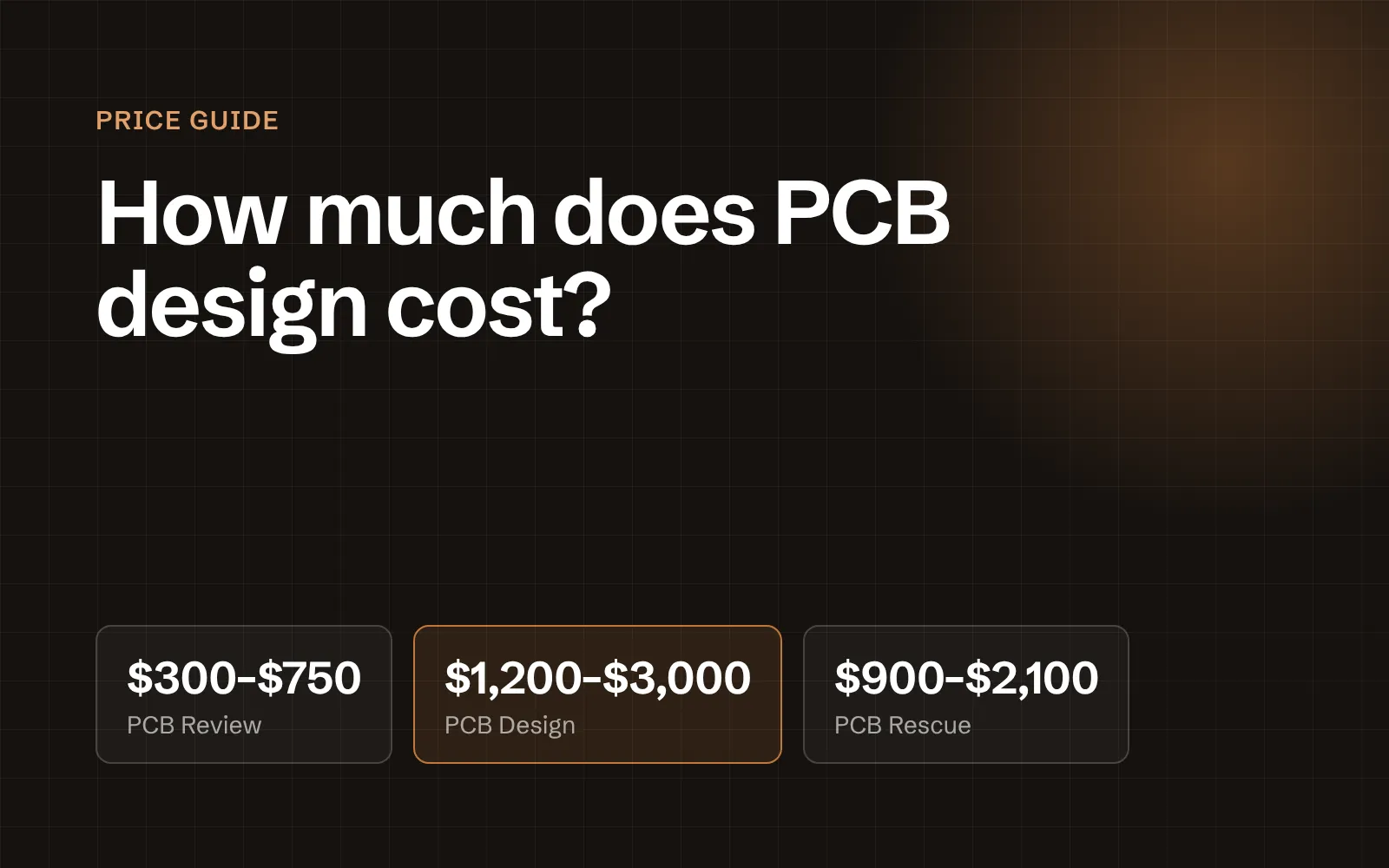
If you are building an electronic product and nobody on your team designs PCBs, this is usually the first question: how much will the board cost me?
Most answers online say “it depends” and stop there. It does depend, but you can still know the range before you talk to anyone. Here I explain how I price my work, and what makes the cost go up or down.
The short answer
These are my typical prices. Keep in mind that, even though you see ranges here, every project gets a fixed quote before the work starts.
| Service | Typical price |
|---|---|
| PCB Review (check your design before you order boards) | $300–$750 |
| PCB Design (from your schematic or requirements to a board ready to manufacture) | $1,200–$3,000 |
| PCB Rescue (fix or finish a board left by another designer) | $900–$2,100 |
Prices are in US dollars, without taxes. Very large or complex boards (for example 6 layers or more) can go above these ranges, and you will always know the price before you hire me.
What makes the price go up or down
A PCB design is mostly engineering time. These are the things that change how much time a board needs:
- Where you start. Starting from a finished schematic is faster than starting from a list of requirements. If you only have an idea, the schematic and the component selection are part of the work.
- Number of layers. A 2-layer board is simpler to route than a 4-layer board. More layers usually means more complex circuits.
- Number of components. A board with 40 parts and a board with 400 parts are very different jobs.
- Board size and shape. A board with many components that has to fit a small enclosure takes more time than one with a more flexible size.
- Wireless modules and fast signals. Bluetooth, Wi-Fi, LTE or sub-GHz modules, and fast interfaces like USB, displays or memory need careful placement and layout, and controlled impedance.
- Power. Batteries, chargers, regulators and high currents need extra care with heat and with how the current flows on the board.
Three examples
To make it easier to understand, here are three example boards and how they usually fit in the price range:
- A simple control board. 2 layers, a microcontroller, USB-C, a few sensors and connectors, no radio. This is at the lower end of the range.
- A connected device. 2 or 4 layers, a Bluetooth or Wi-Fi module, battery charging and a few interfaces. This is usually in the middle of the range. The BLE tag with solar energy harvesting I designed some time ago is a good example.
- A complex board. 4 layers or more, wireless modules, fast interfaces or a very tight space. This is at the top of the range, or above it for very complex boards, like this automotive touchscreen control panel.
What is included, and what is not
With me, you always get the full KiCad or EasyEDA project, the Gerbers, the BOM and the assembly files your manufacturer needs, plus DFM/DFA checks, so the board can be made and assembled without problems.
The following services are not included in my work:
- Manufacturing. The boards and the assembly are paid to the manufacturer. For a few prototypes this is often much less than the design itself, but it depends on size, layers, quantity and assembly.
- Components. The parts on the board, bought by you or by the manufacturer.
- Firmware and testing. The code that runs on the board, and testing the hardware. I offer them as extra services, quoted separately. If you need them, we can talk about it.
- Certification and 3D enclosure design. CE or FCC tests and the mechanical design of the enclosure.
Freelancer, design firm or in-house engineer?
There are three common ways to get a PCB designed:
- A freelancer. Usually the most flexible option. Rates vary a lot: a Cad Crowd guide puts them between $30 and $100 per hour.
- A design firm. More people and more process, at a higher rate: about $90 to $145 per hour in the same guide. It makes sense for large, full-product projects.
- An in-house engineer. A full salary, plus tools and training. It makes sense when you have PCB work every week, not a few boards a year.
If you need PCB work every month but not a full-time hire, a monthly plan with reserved hours (like my Hardware Partner plan) may be what you need.
Why a very cheap freelance quote can cost you more in the long run
I say this from experience. Several of the projects I have taken on came from clients who tried a very cheap option first, and sadly they all followed the same pattern, one that is common in freelance work: the designer stops answering, the files are incomplete, or the first boards come back and do not work. Fixing that is what a PCB Rescue is for. And with me you will not have that problem: I reply quickly and keep you updated during the whole project.
Most hardware projects need several revisions of the board. That is normal: some problems only show up when you test the hardware. But each revision costs money for the boards and parts, and several weeks of waiting. A professional design keeps those iterations to a minimum, and a cheap design that has to be redone from scratch usually costs more than a fair price paid once (again, I have had several clients in this situation).
Some things to check before you hire anyone, whatever the price:
- Do they answer quickly and clearly, like a person who has read your message, and not with generic replies clearly written by AI?
- Can they show a portfolio of boards they designed, and verified reviews from previous clients?
- Do they have proven experience in the industry, and an engineering degree or a similar background?
- Are they willing to sign your NDA before you share files?
- Do you get the source project, not only the Gerbers?
- Is the price fixed, with a defined scope and delivery date?
If you are still not sure, ask them for a short video call. A serious designer will be happy to meet you and talk about your product before you share any files. If you want to talk with me first, send me a message and we schedule a call.
How to get a price for your board
The fastest way to get an exact price is to share what you have: requirements, a schematic or existing design files. The more you tell me about your project and needs, the more precise the quote and the estimated delivery time.
You can send me your project here. I reply within 1 business day, and if you need an NDA first, I sign it before you share anything.